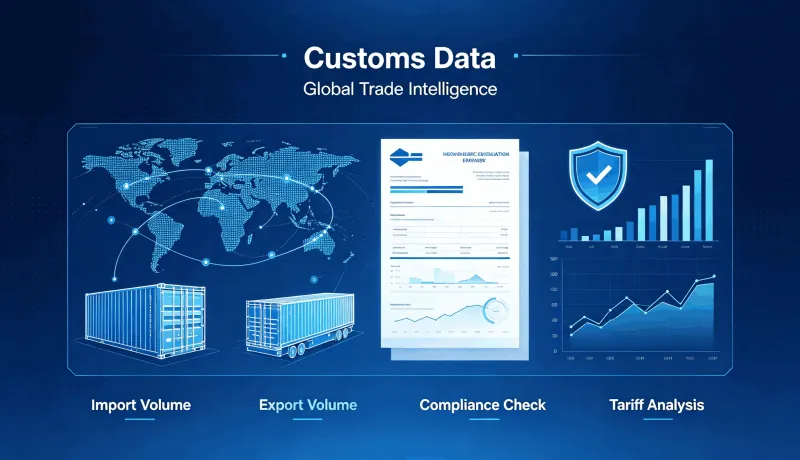
Most B2B sales teams still build prospect lists from industry directories and purchased contacts, then send cold email and hope. The results are predictable. Average reply rates sit around 5.8 percent, and buyers have already completed roughly 60 percent of their research before they agree to talk to a vendor. Customs data changes the game because it starts from a different question: not “who might need our product?” but “who is already buying it?”
Every time goods cross a border, a customs declaration or bill of lading is filed by law. Those records, which name the buyer and seller and describe the product, quantity, value, and route, are public in many major economies. This guide explains what customs data contains, why it outperforms traditional lists, and five practical ways to turn it into a pipeline of high-value leads.

Why Generic Prospecting Misses High-Value Buyers
Industry lists describe companies. Customs data describes behavior, and that difference decides whether outreach lands. Consider what buyers do before you ever contact them:
- 71 percent of B2B researchers start with a generic search, not a brand search, according to Google’s research.
- The average buyer runs about 12 searches before engaging a vendor.
- A Belkins analysis of 16.5 million emails put the average B2B cold reply rate at 5.8 percent in 2024.
Cold outreach fails because it interrupts strangers who have no reason to respond. A company that imported your product category last quarter has a reason: an existing need, an approved specification, and a budget. That is the difference between a guess and a lead.
What Customs Data Actually Contains
Customs data is assembled from the declarations and bills of lading filed whenever shipments cross borders. The WTO values world merchandise exports at USD 24.43 trillion in 2024, and a meaningful share of that flow leaves a public paper trail. S&P Global’s Panjiva platform alone indexes more than 2 billion shipment records covering over 9 million companies in roughly 190 countries.
A single record typically shows the shipper and the consignee, the HS code and product description, quantity, value, country of origin, and ports of loading and discharge. Compare several records for the same company and you can see how often it buys, how much it spends, whether it is growing, and which suppliers it uses. Because the records are filed for customs purposes, they reflect money actually spent rather than self-reported interest. That is enough to qualify a prospect before the first email is sent.
5 Ways to Turn Customs Data Into High-Value Leads
1. Build Buyer Lists by HS Code, Not Industry Keywords
Industry keywords return companies that might buy. HS codes return companies that demonstrably do. In one walkthrough, a ceramics exporter targeting the US market searched HS code 6911, which covers porcelain tableware, and retrieved more than 340 active importers in a single query, each with shipment history attached.
Practical advice: find the 6-digit HS code that matches your product, search import records for the last 12 months in your target market, and export the consignee list. Filter out freight forwarders and trading agents by keeping companies that appear as the final consignee across multiple shipments.
2. Prioritize by Volume, Frequency, and Growth
Not every importer deserves the same attention. A buyer that imports your category three or more times a year has an established need and standardized procurement, so the decision cycle is shorter than for a first-time importer testing the market.
Practical advice: score each lead on shipment count, annual import value, and year-over-year trend, then rank the list. Set a minimum annual import value that matches your deal size so junior reps do not burn time on accounts that can never buy at your price point. In one published exporter case, 50 to 60 percent of new customers now come from a trade-intelligence platform, generating three to five qualified leads per month. Put the top decile in a priority tier and let senior reps own those accounts.
3. Spot Rising Markets Before Your Competitors
Import data shows demand shifting by country and by quarter long before it appears in trade press or exhibition attendance. An Italian manufacturer of agricultural machinery used import analysis to choose its next market. The records pointed to Brazil and Argentina, which showed the highest import volumes and growing demand, so the company built its entry strategy around those two countries instead of guessing.
Practical advice: run a three-year import trend report for your HS code by destination country. Flag markets growing consistently while your current buyers stay flat, then target the top three rising markets with region-specific pricing and messaging.
4. Write Outreach That References Real Shipments
The reply-rate benchmarks explain why warm beats cold. A message that opens with “I see you imported roughly 40 tons through Rotterdam last quarter” proves the sender did homework and gives the buyer a reason to read further. Context beats volume.
Practical advice: reference one concrete shipment in the first line, whether product, volume, port, or a recent supplier change. Follow up at least twice; the first follow-up lifts reply rates by around 49 percent, and campaigns running three rounds average about 9 percent replies, according to Belkins benchmarks. Keep each message under 150 words and end with one low-friction question. If your category rarely appears in customs records because buyers source domestically, search your competitors’ shipments instead and target their customers.
5. Monitor Competitors and Supplier Switching
Customs data also works as an early-warning system. When a target account’s import pattern changes, whether a new supplier appears, volume drops, or origin shifts, a renegotiation window usually opens. That is the moment an incumbent supplier is most vulnerable.
Practical advice: set alerts on your top 20 target accounts and your three closest competitors, then review their consignee lists quarterly. When a competitor loses a shipment to another supplier, move that buyer to the top of your outreach queue within the same week.
A Simple Workflow to Start This Week
- Confirm your product’s 6-digit HS code against your own shipments.
- Export active importers from the last 12 months for your two priority markets.
- Score the list on volume, frequency, and growth, then keep the top 10 percent.
- Enrich each account with a named decision-maker and write one shipment-specific opener.
- Launch three-round sequences, review reply rates weekly, and drop non-responders after 30 days.
Conclusion
Customs data does not replace selling; it replaces guessing. A buyer already importing your category carries the strongest signal a sales team can get: demonstrated demand with a budget attached. Build the HS-code list, score it on behavior, and reference real shipments in every touch. The pipeline that results is full of contacts who were never truly cold.