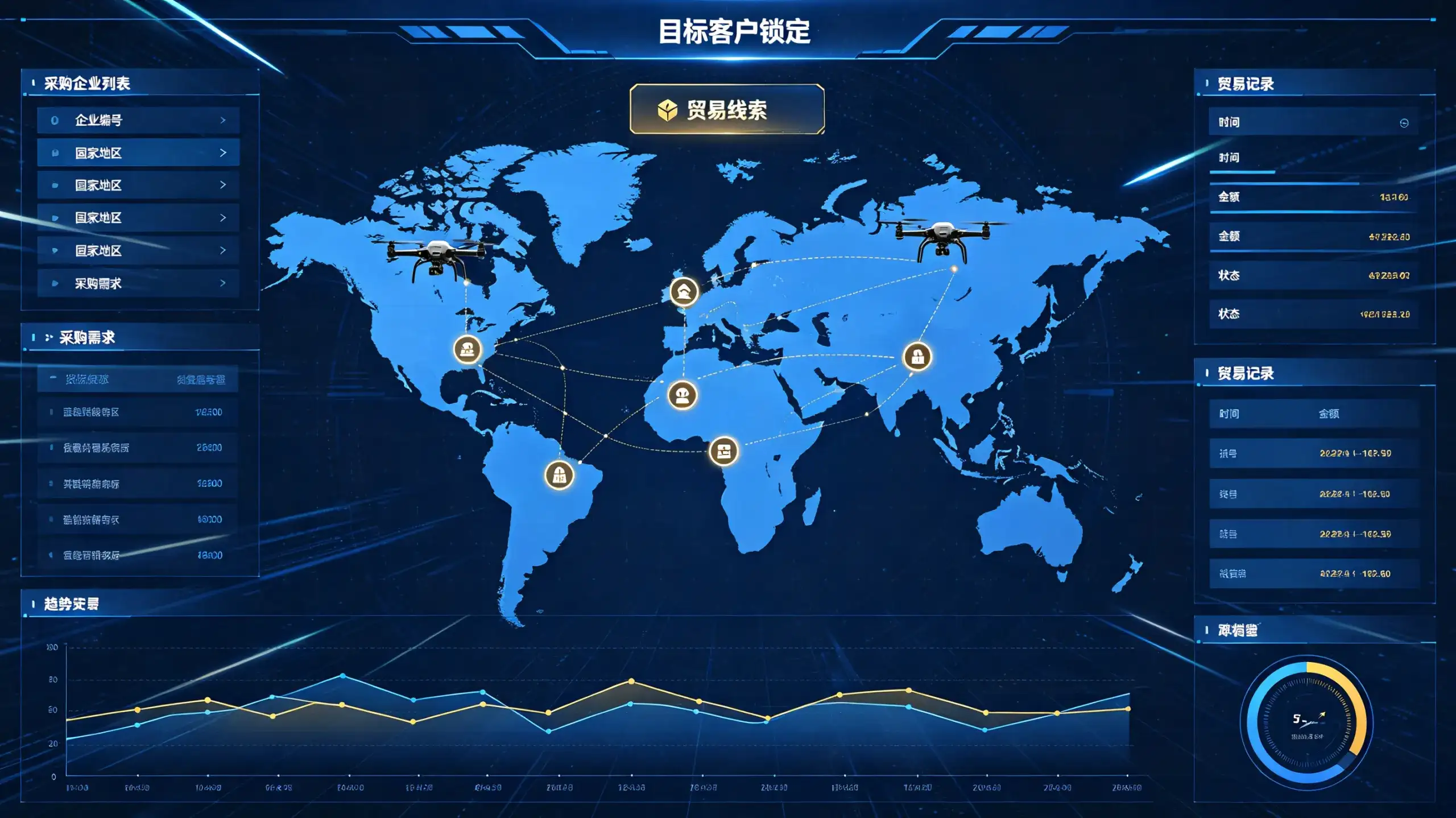
Most export businesses struggle with inefficient buyer development. Many exporters rely solely on trade fairs and B2B platforms, facing fierce competition, high customer acquisition costs, and low lead conversion rates. According to global trade industry statistics, over 68% of active overseas importers do not frequently participate in offline exhibitions or update information on B2B platforms. These hidden high-quality buyers can only be accurately located through official customs data and real trade records. Unlike passive customer waiting, customs data-driven buyer hunting is a targeted, data-backed strategy that helps exporters lock in verified, purchasing-intent buyers and cut invalid sales outreach. This article shares practical, step-by-step methods with real industry cases to help export enterprises leverage trade records to expand stable overseas clients.

1. Screen Accurate Target Markets via HS Code Trade Data
The core premise of finding high-value buyers is to clarify high-demand target markets, and blind global outreach will only waste time and human resources. Customs data and UN Comtrade official trade records record the import volume, growth rate, and market demand cycle of each product in various countries, serving as the most reliable basis for market positioning.
The most practical operation is to use the 6-digit universal HS code of core products to filter global import data. First, confirm the standard HS code of your product, then query the import volume, year-on-year growth rate, and major importing countries in the past 12–24 months through authoritative trade databases. Prioritize countries with stable annual import volume and continuous growth, and avoid markets with saturated demand or sharp import declines.
A typical real case comes from a Foshan-based ceramics exporter specializing in porcelain tableware (HS code 6911). The enterprise filtered US customs trade records of the past two years and found more than 340 active local importers with stable procurement records. After excluding small retailers with fewer than 4 annual shipments and an average order value below $15,000, it locked 82 medium and high-quality stable buyers. This targeted market screening helped the enterprise abandon scattered low-demand markets and focus on high-potential US regional clients, laying a foundation for subsequent efficient customer development.
2. Filter High-Value Verified Buyers from Customs Records
Many exporters mistake all recorded importers as potential customers, but a large number of traders, small distributors, and sporadic purchasers are mixed in trade data. Screening high-value verified buyers is the key to improving conversion efficiency, and all screening standards are derived from real customs transaction records.
There are three core practical screening dimensions. First, check procurement stability: retain buyers with continuous import records for more than 12 months and regular shipment cycles, eliminating one-time purchasers. Second, verify order strength: screen importers with annual import volume of no less than 5 containers or an average single order value of over $20,000, which conforms to the procurement capacity of formal middle and downstream distributors. Third, eliminate competing suppliers’ exclusive customers: exclude buyers with long-term fixed cooperative suppliers and stable annual procurement proportions to avoid invalid development.
A Chinese biodegradable packaging exporter adopted this screening logic in EU market development. It initially screened more than 800 EU local importers of PLA biodegradable bags through customs data, then eliminated small merchants with annual imports below 5 containers and top chain brands with fixed suppliers. Finally, it retained 126 mid-sized distributors with stable demand and replacement willingness. Within six months, the enterprise successfully converted 11 long-term cooperative buyers, with a customer conversion rate 42% higher than the industry average.
3. Analyze Buyer Demand Traits to Customize Outreach Strategies
The biggest disadvantage of traditional customer development is generalized mass outreach, which leads to extremely low email reply rates. Customs and trade records can intuitively reflect buyers’ product preferences, price acceptance, procurement cycles, and logistics preferences, helping exporters customize personalized outreach plans and improve reply and transaction rates.
The specific operation is to sort out the buyer’s historical trade details: analyze the product specifications, material standards, and packaging styles of their imported goods, clarify their core demand preferences; count their average order price and freight methods to formulate competitive quotation schemes; summarize their fixed procurement cycles to grasp the optimal customer development time node.
A Changzhou electrical equipment enterprise used customs data to avoid development risks and achieve precise breakthroughs. When facing an Iranian buyer who claimed millions of dollars in annual procurement volume, the enterprise queried the buyer’s past year’s customs records and found that its actual annual import volume was only about 300,000 RMB, with messy product categories and no matching electrical product procurement records. The enterprise abandoned this invalid customer in time and focused on 23 matching buyers with stable procurement records. Relying on personalized quotations and product matching schemes based on trade data, the enterprise completed 3 new orders within 3 months.
4. Track Dynamic Trade Data to Tap Replacement Opportunities
Market competition and supplier cooperation are dynamic. Many buyers will have supplier replacement demands due to price increases, unstable quality, or delayed delivery of original suppliers. Real-time tracking of customs trade data changes can help exporters capture blank window periods and seize high-quality orders ahead of competitors.
The daily operational method is to regularly monitor abnormal changes in target buyers’ trade records, including reduced import frequency, interrupted shipment records, and declining procurement volume from original suppliers. These data changes are direct signals of loose supplier cooperation. Exporters can conduct targeted outreach at this time, highlighting their product advantages, delivery stability, and price competitiveness to promote supplier replacement.
According to trade data statistics, enterprises that continuously monitor customs trade dynamics can increase their new customer acquisition volume by 35% annually on average. This data-based dynamic tracking model completely breaks the passive development mode of traditional foreign trade and realizes active precise customer acquisition.
Conclusion
Customs data and trade records are the most authentic and authoritative traffic asset for export enterprises. Different from blind and inefficient traditional customer development, data-driven buyer hunting realizes market positioning, customer screening, demand matching, and opportunity capture with factual transaction data. By standardizing HS code market screening, high-value buyer filtering, personalized demand analysis, and dynamic opportunity tracking, export enterprises can effectively reduce invalid work, improve customer conversion efficiency, and steadily expand stable high-quality overseas buyer groups in the competitive global trade market.